
The Intelligence of Survival: An Indigenous Perspective on Post-Traumatic Growth
Post Traumatic Growth
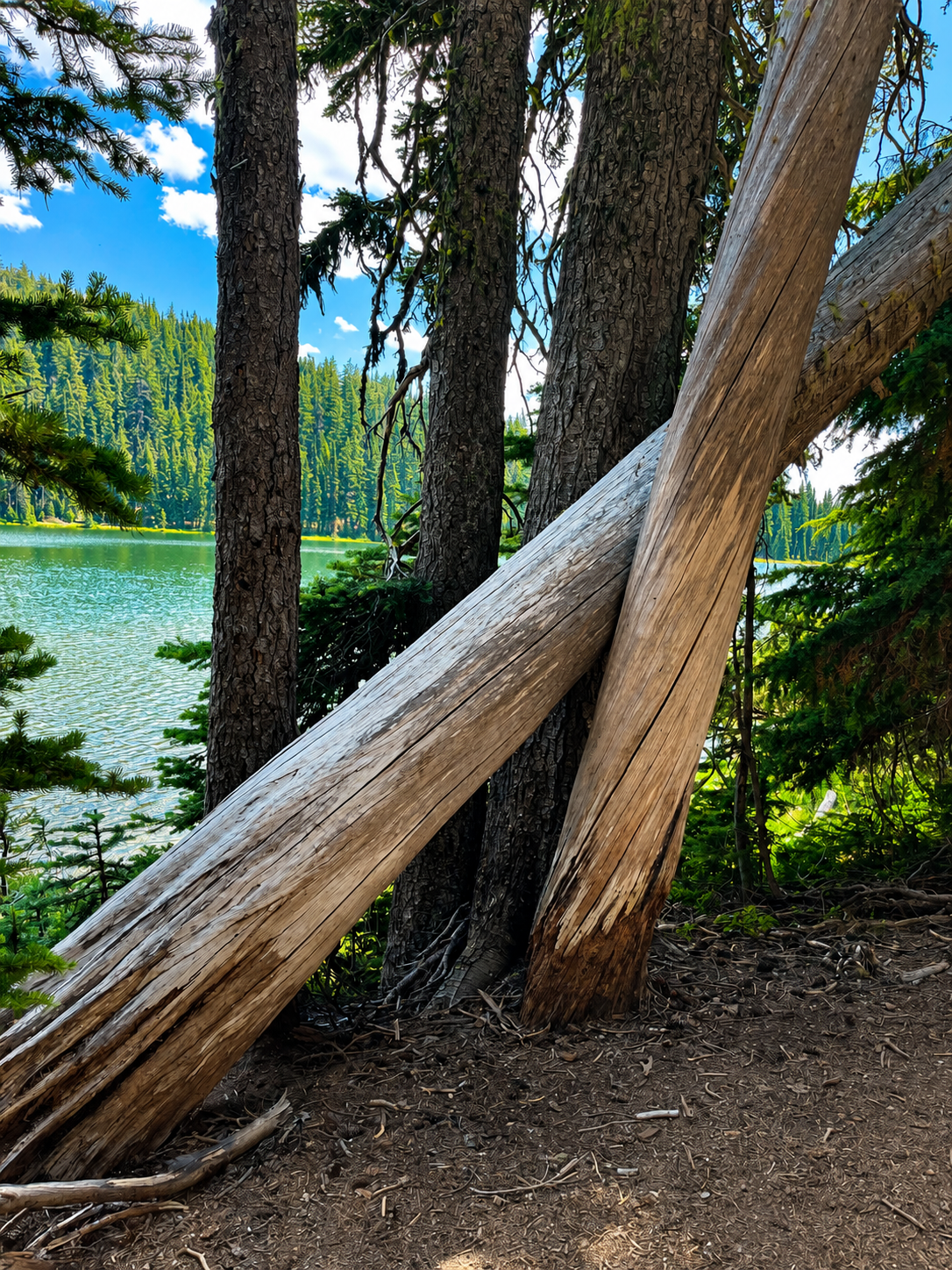
These trees are perched along Todd Lake in Central Oregon. I captured this photo shortly after my husband's car accident. This image became a powerful reminder that healing does not happen alone. Sometimes survival means allowing ourselves to be held by others until we can stand again.
As a therapist, I often sit with people who are carrying the effects of trauma and adversity. Many arrive asking the same question:
"What's wrong with me?"
I find myself asking a different one:
"What happened to you, and how did you survive?"
PTSD has been an official diagnosis since 1980 and has helped us understand the impact trauma can have on the mind and body. Yet I've often wondered whether the diagnosis tells the whole story.
The word disorder can imply that something is wrong with the person. But when I look through the lenses of attachment, eye movement desensitization and reprocessing (EMDR), and the nervous system, I see intelligent adaptations.
I see survival.
In the fall of 2025, I attended a workshop called the SPIRIT WARRIOR | An Ancient Pathway to Modern Courage in Portland, Oregon, hosted by Lynea Gillen of Yoga Calm and led by Dr. Leslie Gray, a Native American clinical psychologist, educator, and scholar whose work integrates Indigenous healing traditions with contemporary psychology.
What struck me most was the emphasis on balance rather than pathology.
The conversation wasn't centered on what was wrong with people.
It was centered on relationship, the balance between suffering and growth, this world and the nonordinary spirit world, resilience, and our remarkable capacity to heal when connected to ourselves and our community.
That perspective has stayed with me.
My own life had been sifting through crisis as my husband had endured a debilitating car accident. I found myself coping in nature, it was safe, nonverbal, and it held me, connected me to something bigger than myself and my experience. I began taking weekly hikes around Todd Lake in Central Oregon, and that’s when I came across the trees pictured above.
I immediately thought of my family.
One of the trees leaned heavily on the others for support. They weren't standing alone.
Neither were we.
Nature has always spoken to me in ways words cannot, and in that moment I was reminded that growth doesn't emerge from avoiding suffering. It emerges through adaptation, connection, and community.
The image became a living metaphor for healing.
This perspective aligns with the work of psychologists Richard Tedeschi and Lawrence Calhoun, who introduced the concept of Post-Traumatic Growth (PTG) in the 1990s. Their research found that many people experience meaningful positive changes following adversity.
PTG recognizes something remarkable about being human:
We are capable of growth through adversity.
We are capable of finding meaning after loss.
We are capable of growing in ways we never anticipated.
We are capable of healing, adapting, and reconnecting after hardship.
To me, post-traumatic growth is not about the trauma itself. It is about what emerges in its wake.
It is the wisdom gained through surviving.
It is the strength discovered when life asks more of us than we thought we could give.
It is the deepening of compassion, the clarity of purpose, and the recognition that we are often far more resilient than we realize.
Post-traumatic growth reminds us that while adversity may change us, it does not have to define us. The human spirit has an extraordinary capacity to adapt, heal, and continue moving toward connection, meaning, and wholeness.
From many Indigenous worldviews, healing is not about fixing something broken. It is about restoring balance and reconnecting with ourselves, our communities, the natural world, and the relationships that sustain us.
Trauma may disrupt those connections, but it does not erase our capacity for healing.
When something overwhelming happens, our systems adapt.
Anxiety makes sense.
Hypervigilance makes sense.
Dissociation makes sense.
These responses often began as acts of survival.
What if we viewed trauma responses not as evidence of pathology, but as evidence of intelligence?
Not intelligence in the academic sense, but the profound wisdom of a nervous system working tirelessly to keep someone alive.
The trees at Todd Lake continue to remind me of this.
The standing trees support the fallen one..
The fallen trees still belong to the forest.
Healing works much the same way.
We heal in relationship.
We heal in community.
We heal when we are witnessed, supported, and held by others.
The remarkable thing is that people survive.
The remarkable thing is that the nervous system continues trying to protect us.
The remarkable thing is that even after grief, loss, betrayal, fear, and hardship, people continue seeking connection, meaning, and healing.
That isn't disorder.
That is adaptation.
That is resilience.
That is growth.
Maybe one day we'll spend less time asking, "What's wrong with you?" and more time asking,
"What wisdom helped you survive?"
Because beyond the diagnosis is a story of human resilience.
And beyond the trauma is the possibility that healing is not about becoming someone new.
It is about remembering who you were before the world taught you to forget.
Healing happens in safety, connection, and community. Post-traumatic growth may simply be the process of returning to those parts of ourselves that trauma could never take away.
Jacey Riedl, LPC
Licensed Professional Counselor, Oregon C7786
About the Author
Jacey Riedl is a Licensed Professional Counselor in Central, Oregon. She specializes in trauma, attachment wounds, anxiety, life transitions, and nervous system regulation. Drawing from a foundation of attachment-based therapies, somatic therapies, and EMDR approaches, Jacey believes healing occurs through safety, connection, community, and our innate capacity for growth. She works with adolescents and adults seeking to reconnect with their authentic selves and move toward greater wholeness and well-being.